
Russia’s invasion of Ukraine and the resulting sanctions from the international community set new records for gas prices in Canada.
They rose to over $2 per litre in B.C. and The Northwest Territories, with prices in Ontario and Quebec following that benchmark closely at $1.76 and $1.84 per litre, respectively. Gas prices were already high in mid-February, with the national average at $1.56 per litre, only to rise by over 20 cents at $1.78 per litre a month later according to the Canadian Automobile Association.
Though gas prices did drop by about $0.15 soon after in some provinces, no one is sure if that’s an aberration as oil market volatility continues. Some experts still predict that the price of oil could reach $240 per barrel this summer if more sanctions are imposed on Russia’s oil exports.
Thankfully, even with the present moment as the backdrop, it’s not all bad news. You can still wade through high gas prices and save a little money. You just have to be strategic about it.
This is why we’ll show you 5 ways to save money on these high gas prices in Canada below.
Never miss an amazing deal again + get our bonus 250+ page eBook for FREE. Join 50,000 other Canadians who receive our weekly newsletter – learn more.
Cut into high gas prices by driving less
It may seem obvious, but the number one way to beat high gasoline prices and save money on gas is to drive less.
Carpooling alone will not only cut your gas expenses in half, but save wear and tear on your vehicle, save on parking, and shorten your commute by taking advantage of HOV lanes.
But that’s only one way to save on gas prices in Canada by not driving. There are other strategies, with various bonuses that come with them, on top of the money you’ll be saving, and we’ll be going through them here.
Take public transportation
With gas prices soaring, more and more Canadians are turning to public transportation for relief, as some are spending $100 per week on gas otherwise.
Riding the bus or the train is a good move because doing so saves on owning a vehicle, which is usually the second biggest expense for most Canadians after rent or mortgage payments when you factor in the following:
- the cost of the vehicle,
- maintenance,
- insurance,
- parking,
- tires,
- licence and registration fees, and
- gas.
For example, gas alone costs $3,000 a year for the average pick-up truck and all the expenses above can run you anywhere from $8,600 a year for a compact car to $13,000 a year for a pick-up truck. Compare that to public transit and the average annual cost is around $940 – 10 times cheaper than the cost of a car.
Plus, many credit cards actually reward you with points and cash back just for taking any form of public transportation, including Uber, Lyft, or taxi along with buses and trains. They either reward you directly for any expense that counts as public transportation, or they reward you through recurring bill payments, of which a transit pass would be one.
Let’s take a look at the top 3 public transportation awards you can get from credit cards in Canada, that help you dodge high gas prices and give you something back for doing it.
| Card | Public Transit Reward |
|---|---|
| American Express Cobalt | 2 Amex Rewards per $1 spent |
| BMO eclipse Visa Infinite Card | 5 BMO Rewards per $1 spent |
| American Express Air Miles Platinum Card | 1 Air Mile for every $5 spent |
For more details on these and other credit cards that reward you for taking public transit, including the other rewards they offer, visit our Best Gas And Transit Credit Card In Canada article.
Use a ridesharing service or take a taxi
If the idea of cramming into a stuffy, slow-moving bus in the summer doesn’t appeal to you, then door-to-door service might be your best option for saving money on gas.
However, the margin for saving on high gas prices in Canada is going to be much less than public transit due to fares, service fees, and fuel surcharges.
Amid higher gas prices, Uber announced a surcharge of $0.50 on every ride that will go directly to drivers. Many taxi companies across Canada are also either considering or currently charging a fuel surcharge of their own. For example, Casino Taxi of Halifax added a $1.30 surcharge on all rides.
But even with the increased cost, taking Uber or a taxi still saves you more on gas every year than driving.
As you can see, ridesharing generally costs half as much as owning anything bigger than a compact car. The annual cost of using a ridesharing service like Uber was calculated using the Ride Or Drive Calculator.
Though it is American, it factors in the cost of a vehicle (in this case, $30,000 with a 1.9% interest rate, a monthly payment of $3,000 and a loan term of 84 months with a fuel efficiency of 25 miles per gallon) as well as direct expenses like fuel, insurance, and licence and registration fees. In addition, it also adds indirect expenses like parking, average property tax on a garage and other garage expenses.
This is compared against a rideshare with a base fare of US$2.30, a distance fare of US$1 per mile, and a time fare of US$0.12 per mile. The minimum fare was $5.30 with a surge multiplier of 2.5 times the price, and a percentage of rides during surge pricing at 5%. It also factors in the cost of your time, which was calculated at $35 per hour.
Any way you slice it, ridesharing cuts your car costs by 50%. Feel free to input the values required by the Ride Or Drive Calculator and see how much you would save by ridesharing over driving to see for yourself.
Meanwhile, the taxi number was taken from a comparison between the cost of owning a car and taking a taxi done at the Tough Nickle Blog, the writer came out with a savings for himself personally of US$1,815 per year with car expenses of US$18,095.
However, based on our estimates, it really depends on the kind of car you have and how often you’re using taxis to know whether taxis even come close to saving you anything. Taxis certainly can be the more expensive cost as they are in the chart above.
Ridesharing is certainly the clear winner and though Uber’s monthly $9.99 UberPass membership only gives discounts on delivery in Canada, thanks to $0 delivery fees with UberEats, you do get a monthly Rides Perk as part of the benefit.
These are usually percentage discounts on Uber’s more premium ride styles, like Uber Comfort or UberXL if you order by a certain date within the month, which could give you a better ride for more typical ridesharing prices.
Some credit cards also offer rewards for using ridesharing services like Uber or Lyft. For instance, if you’re an Aeroplan cardholder, you can get a free Uber Pass subscription for 3, 6, or 12 months. Read Best Cards For Taxis, Uber, And Lyft for more details.
Use car sharing
If you want to save on gas prices in Canada but you still want the freedom of driving a car, that’s doable, as long as you don’t care whether the car is your own.
Car sharing services like Zipcar, Turo, Modo, and Eligo all allow you to pick up a car and drive it to your destination for much cheaper than it would cost to rent a car from a large rental company like Hertz, Alamo, or Enterprise.
Of course, these companies are adding fuel surcharges to combat high gas prices. For example, at the B.C.-based Modo, for every $0.10 that the price of gas rises over $1.60 per litre, their drivers will pay an additional $0.10 for every kilometre they drive.
However, you’re easily still saving compared to owning a car because at least at Modo you don’t have to pay for gas, insurance, or parking.
Similarly with a lot of these carshares, gas and insurance are included in the price. That’s the way it works with Zipcar (a subsidiary of Avis Budget). They will either charge you per hour or per day to drive their cars (usually $14 per hour and up to $172 per day). If you’re a frequent user, both Modo and Zipcar allow you to sign-up for monthly plans for greater savings.
Eligo and Turo work a bit differently from a traditional car rental; you’re not renting from a fleet but you’ll be renting a person’s actual car that they’ve put up for rent on the site. In both cases, you’ll have the option of signing up for a car insurance plan if you don’t have car insurance of your own.
Meanwhile, some drivers will require you to return their car with a full tank of gas while others will not. Feel free to read about Turo Canada for more details on that car sharing service specifically.
Of course, if you’re car sharing, you’re probably driving less frequently, so you’re automatically bypassing those steep gas prices, but how much are you actually saving?
Well, if you use the right car sharing service, you won’t be paying for fuel at all during those trips. Car sharing companies with a fleet of cars, like Zipcar, either reimburse you for fuel expenses or provide you with a pre-loaded gas card for filling the tank.
Even in cases like Turo, where you are required to fill the tank of the host’s car at your own expense, this is not always the case. Some drivers don’t care what level the gas tank is at when you return the car and will tell you so in their rental listing, so simply look for those listings and you’re free and clear.
As for the other expenses that come with owning a car, Zipcar also covers parking, maintenance, and insurance. The company says, including fuel, this amounts to a potential savings of $600 a month over owning a car.
Based on the car sharing experience of travel blogger LarkyCanuck, who spent $500 using car sharing 7 times in a month compared to what they calculated as their $570 a month car ownership cost, Zipcar’s $600 monthly estimate is at least in the right ballpark.
Work from home
Even with provinces having already lifted or planning to lift all COVID restrictions, some companies have announced plans to keep working from home regardless of the status of the pandemic. If your company is one of them, congratulations – you’ve just hit a savings on gas prices that most of us have probably never experienced until now.
Current CRA mileage allowance rates for 2022 are $0.61 per kilometre for the first 5,000 kilometres driven and then $0.55 per kilometre thereafter. According to The Globe and Mail, the average commuter drives between 5,000 to 10,000 kilometres to work per year representing a savings of between $3,050 and $5,800 annually. The savings includes gas, as well as maintenance and insurance on your personal vehicle.
For those that aren’t as lucky and find themselves going back to the office, perhaps such a savings is worth approaching their boss about implementing a work from home plan.
The savings aren’t just for the employees either. Management won’t have to pay as much in a building lease and the associated office expenses if the company adopts a work from home or even hybrid model. Plus, management themselves will get to save on gas prices too. For the employees, many business credit cards give cash back or points on many expenses they would need to invest in for setting up a home office, including the following:
- recurring bill payments like phone or internet,
- technology purchases, (in some cases, purchases specifically from Apple or Best Buy)
- office supplies, and
- electronics.
For more on what else bosses can glean from business credit cards, read our article on How To Rebuild Your Small Business After COVID-19.
2. Make the switch to an electric vehicle
If you want to go all in on saving money on gas prices, the most full-bore commitment would be making the switch from a vehicle that runs on fuel to one that runs exclusively on electricity.
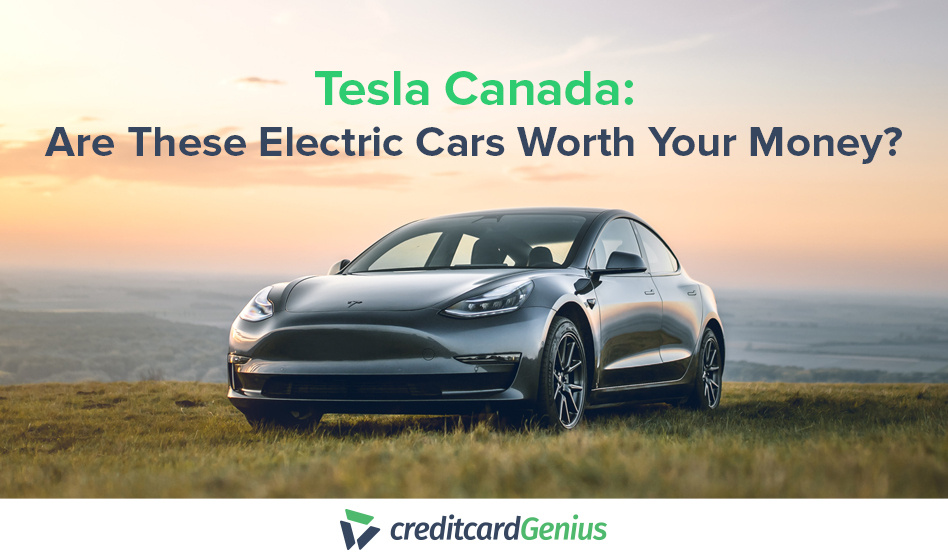
If you’ve been thinking about it, we can offer that final push because we’re giving away a Tesla Model 3 right now. Go to our offers page to enter to win.
If you do snag that Tesla, not only will you be an environmental darling, but you’ll save copious amounts of money on gas and won’t even have to consider those high gas prices plaguing everyone else driving their inefficient gas-powered cars.
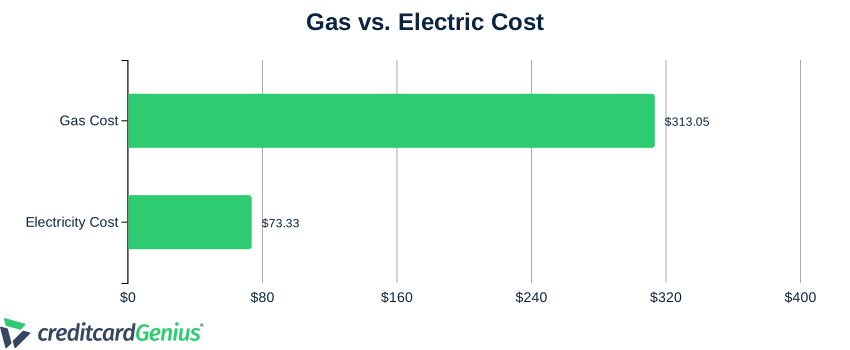
Check out how much you can save with an electric vehicle vs. the cost of owning a gas guzzler in just over a month.
In terms of savings and bypassing those high gas prices, switching to an electric vehicle will save you $239.72 or, to put it another way, 24% in just 30 days of driving.
The data comes from a member of the creditcardGenius Team who has been driving a Hyundai Ioniq 5 since the middle of February 2022, which means a month as of this writing. So far, they’ve driven 2500 kilometres and expended 21.47 kilowatt hours per 100 kilometres.
The gas cost comes from what they would’ve spent had they driven their gas-fueled car the same distance at a gas price of $1.67 per litre.
After driving for about a month, they’ve already saved almost $240.00. The savings would be even higher if that was extrapolated over the course of a year with an electric vehicle. There is an annual maintenance cost for electric vehicles, which is estimated to be around $100, but even that pales in comparison to the cost of maintaining a car that runs on gas.
.
3. Use a gas tracker app to find the best gas prices
Another strategy you can use for saving money on gas prices in Canada is to download and use a gas tracker app on your smartphone.
Basically these apps use GPS to find the cheapest gas price in your immediate area. One of the most popular ones, GasBuddy, reports on their website that it saves people US$990 million on gas per year based on 900 million searches over the same period.
To decide which one you should go with, we’ll compare the pros and cons against each other and then talk about each of the 4 leading gas tracker apps in detail.
| Gas App | Pros | Cons |
|---|---|---|
| GasBuddy | * User-reported gas prices * Free to use * Shows the spread between lowest and highest price * Can choose type of gas (regular, premium) * Can show cash or credit prices * Can show price, distance, or both * Can sort by gas brand * Can sort by amenities * Can confirm right or wrong price * Earn points to win $100 gas card * Get notified about recalls on your vehicle * Track your driving to improve driving habits |
* Gas prices aren’t always accurate * $100 daily gas card hard to win * No Pay With GasBuddy * Ads can be distracting |
| Waze | * Get live traffic updates * Plan routes * Set preferred fuel type * Set things to avoid on your route including tolls, ferries, freeways, unpaved roads, and difficult intersections * Connect calendar * Set favourite stores * Faster with traffic updates than Google Maps * Crowdsources data |
* Cluttered layout * Not a dedicated gas tracker * Icons difficult to understand * Can send you on wrong or inconvenient routes * High consumption of data and battery life * Christina Aguilera navigation voice |
| CAA Mobile | * Request roadside assistance in-app * Don’t need CAA membership to use * Cash in on nearby retail discount offers, including gas * Get gas delivery within 24 hours |
* Some features restricted without CAA membership * Ad heavy * Gas comparison only web-browser based * Not a true gas tracker |
| Fuelio | * Choose map or list view * Track vehicle expenses and costs * Track gas costs * Log mileage * Compile personal vehicle stats * Create service, odometer, or expense notifications * Simple interface * Add more than one vehicle * Trip log * Backup to Dropbox * Set preferred currency |
* Takes a while to ideally set up * Stats and information can get complex |
GasBuddy
GasBuddy is arguably the most popular free and dedicated app when it comes to gas tracking.
It’s easy to use, setup takes minutes, and it simply shows you where the cheapest gas in your area is based on data submitted by other users in real time. The interface is a simple list which you can organize according to preferred brand of gas, type of gas, distance, and more.
Users are incentivized to submit information on prices because they can earn points which go toward entries in a daily draw for a $100 gas card. Though the information on gas prices isn’t always accurate because it’s user-submitted, you can fact-check the listed price as a user yourself by confirming or rejecting it when you’re nearby. The only other drawback besides accuracy is that users in the States can request a Pay With GasBuddy card. This is a debit card that gives them up to $0.25 off of gas at participating stations when linked to a debit account, but it isn’t available in Canada.
Waze
Waze is not a dedicated gas tracking app, but it will find nearby gas stations in your vicinity based on your price and fuel preferences. It uses a map interface just like Google Maps and allows you to find way more than nearby gas stations.
You can input frequent trips, sync your calendar, get real-time traffic data, and set which driving landmarks you want to avoid such as busy intersections, unpaved roads, and tolls. It’s also possible to input your favourite restaurants and retail locations so you know when you’re nearby and get exclusive offers from these locations.
Though it is free to use, the drawbacks are it will sometimes send you on inaccurate or inconvenient routes to your destination, the interface and icons are distracting and confusing at times and you can select Christina Aguilera as your navigation voice, which is only good if you get a kick out of that sort of thing.
Plus, since it’s not a dedicated gas tracker, you often get the sense that it’s trying to serve too many masters. In our view, it can be too busy and cluttered to be properly functional.
CAA Mobile
On this one we’re cheating a bit because CAA Mobile is more of an app for requesting roadside assistance than it is a gas tracker.
That being said, you can get fuel delivery within 24 hours if you really need it and there are various retail discount offers for CAA members that you can redeem when you’re near the relevant locations on the road. These offers also include gas offers from stations like Shell.
While you don’t need a CAA membership to use the app (you can use it as a guest), many of its features are restricted without putting in a membership number. You can still call for roadside assistance and look at the available retail offers though.
You can get updated gas price information through the CAA website, but if you’re looking for a dedicated gas tracker, this isn’t it.
Fuelio
Fuelio is the most comprehensive gas tracker on this list. It allows you to choose between a list and a map view, so it gives you the best of both interfaces between GasBuddy and Waze. In addition to tracking gas though, you can also track your gas expenses over time, as well as the cost of gas as you fill up.
You can track other car related expenses and costs such as repairs and maintenance. The more detailed you input your car information, the more accurately it can notify you when it’s time for an oil change and other regular upkeep appointments. Preventive maintenance and fixing things before they break can save you thousands in the long run.
You can also track mileage, log costs, as well as trips, before seeing it all in various charts and graphs. Do it long enough and you can start to collect statistics on your own car and driving habits.
Even still, it can all get pretty heady and complicated. Plus, inputting all the detailed information on your own car can be time consuming before you even start using the app, but if you’re a big numbers person, it may be the only driving and car care app you’ll ever need.
Our verdict
If you’re looking for something that’s one-stop and completely comprehensive for everything needed when tracking not just gas, but your car in general, Fuelio is the app to use. However, if you’re not as much of a gearhead and just want to track gas in an uncomplicated, non-cerebral way, then GasBuddy is the choice for a layman like you.
4. Driving better will actually save on gas prices
This is the point in the article where we admit that you’ve been had. You actually need nothing special to save money on gas prices. To be honest, a lot of the savings comes from driving better and to a large degree, smarter.
Here’s our curated collection of strategic driving tips that will increase your vehicle’s fuel efficiency and in the long run, save you money.
Don’t idle for too long
We know you’re not Canadian if you don’t warm up your car before your morning commute on a cold winter day. Hell, how many Canadian Tire commercials selling antifreeze and alternators has the whole practice been immortalized in? But, we’re here to tell you to go against those dyed-in-the-wool Canadian instincts and keep your warm ups short. If you can keep it all business, at about 30 seconds or less, you might be colder but you’ll thank yourself later since you won’t need to spend as much on gas.
Fill up before the tank is empty
The road to hell is paved with good intentions and the road to getting gouged on gas is paved with desperation.
Think about it, the moment your tank is down to its last drop is the moment you’re driving around like a wildman, looking for that gas fix, and willing to pay any price to get it. Particularly with the high gas prices we’re seeing now, you just can’t afford to do that – literally.
Instead, be smart and plan ahead. Fill the tank long before you absolutely have to and you can afford to hunt for the cheapest price you can find without needing to stomach the first ripoff price at the nearest gas station.
Check tire pressure and tune up your engine
You can save money on gas prices simply by doing some basic vehicle maintenance. This includes making sure your tires are fully pumped up and going into the shop for regular oil changes. Also, making sure you’re using the right oil goes a long way.
You probably didn’t know that fuel efficiency drops 1% for every 3.0 PSI that tires are below recommended levels, which are between 32 and 35 PSI. You’ll actually save $65 a year because you will increase the life of your tires, which keeps your car fuel efficient.
Even General Motors will tell you that a properly tuned engine will improve fuel economy by about 4%, so don’t ignore those check engine lights, weird rattles, and little warning signs your car is always making because doing so will cost you even more at the end of the day.
Take stuff out of your trunk
Carrying excess weight wastes gas – it’s as simple as that. In fact, for every 100 pounds in your trunk, fuel efficiency drops by 1 to 2%. This means that if you don’t need something for your trip, don’t take it because there’s no sense dragging around more junk in your trunk.
Speaking of drag, you should remove roof racks to make your car more aerodynamic because keeping them on creates drag and also affects your car’s fuel efficiency, so try to make your car as aerodynamic as you can if you want to save money on gas.
Use AC on smaller cars and roll down windows on larger ones
One of those eternal questions around cars is do you put the windows down on a hot day or do you turn up the AC?
Well, it actually depends what kind of car you have.
For larger cars, opening the windows won’t make a big difference in terms of reducing drag because large cars have enough drag already to have a lower fuel economy than their smaller counterparts. Therefore, you can keep the windows open to your heart’s content.
With smaller cars however, opening the windows can create enough drag to affect the outcome significantly on fuel efficiency, so avoid opening the windows and use the AC instead.
Improve your driving technique
We’ve discussed driving smarter and now it’s time to talk about driving well. A good technique that can conserve fuel is the lifting and coasting technique.
Lifting and coasting is a driving technique race car drivers use that maximizes fuel efficiency and it can be adopted by civilian drivers to do the same. The technique is basically when a driver lifts their foot off the accelerator and coasts in order to spend less time on the throttle, which in turn uses up more gas.
The same principle applies when you’re anticipating traffic lights, which again avoids stopping and starting. It’s about gentle anticipation, not flooring it, and not throttling too much when driving a standard.
Not only does such technique produce a smoother ride for you and your passengers, but it will ensure your fuel consumption remains reasonable, which will bring you back to the gas station less frequently.
5. Credit cards can give you cash back on high gas prices
You’ll also be able to save on gas prices in Canada with the right credit card. The following credit cards give cash back and rewards on gas prices, which basically pay you back for your pricey stop at the pump because the more you buy, the more cash back or points you can redeem.
The cards on the table below can lessen your pain at the pump with their rewards on gas purchases.
| Credit Card | Welcome Bonus | Rewards | Annual Fee, Income Requirements | Apply Now |
|---|---|---|---|---|
| American Express Gold Rewards | 60,000 points (terms) | * 2 points for every $1 spent on gas, groceries, drugstores, and travel * 1 point for every $1 spent on all other purchases |
* $250, * $0 personal/$0 household |
Apply Now |
| Tangerine Money-Back | Earn an extra 10% cash back for the first 2 months, up to $1,000 spent (terms) | * 2% cash back on purchases in up to 3 Money-Back Categories * 0.5% cash back on all other purchases |
* $0, * $12,000 personal |
Apply Now |
| American Express SimplyCash | 5% cash back for the first 3 months, up to $2,000 in spend (terms) | * 2% cash back on gas * 2% cash back on groceries (up to $300 cash back annually) * 1.25% cash back on all other purchases |
* $0 | Apply Now |
| CIBC Dividend Visa Infinite | None | * 4%† cash back on eligible gas, EV charging, and groceries * 2%† cash back on eligible restaurants, transportation, and recurring bills/payments * 1%† cash back on all other purchases |
* $120, * $60,000 personal/$100,000 household |
Apply Now |
| BMO Eclipse Visa Infinite | 80,000 points (terms) | * 5 BMO Rewards points for every $1 spent on dining, groceries, gas, and transit * 1 point per $1 spent on all other purchases |
* $120, * $60,000 personal/$100,000 household |
Apply Now |
| Amex Cobalt | 15,000 points (terms) | * 5 points per $1 spent on eligible groceries and restaurants (up to $2,500 spent per month) * 3 points per $1 spent on eligible streaming services * 2 points per $1 spent on eligible gas, transit, and ride share purchases * 1 point per $1 spent on foreign currency purchases * 1 point per $1 spent on all other purchases |
* $191.88 | Apply Now |
† Terms and conditions apply.
American Express Gold Rewards
When it comes to rewards, the
- 2 points for every $1 spent on gas, groceries, drugstores, and travel
- 1 point for every $1 spent on all other purchases
You can redeem your American Express Rewards for flexible travel rewards, 1:1 transfers to airline loyalty programs, or statement credits. Your best option for redemption comes when you transfer your Amex Rewards 1:1 to Aeroplan where they are worth 3 times more as Aeroplan Miles.
With so much opportunity to travel, you’ll be happy to be redeeming so much based on the current high gas prices.
The only possible sticking point might be the $250 annual fee, which is significant. Thankfully, if you travel often, the flexible reward redemption opportunities make it worth it.
Tangerine Money-Back Mastercard
GC: $120 + $20

The
- 2% cash back on purchases in up to 3 Money-Back Categories
- 0.5% cash back on all other purchases
One of those categories can be gas if you so choose, which will make any increasing gas prices that much less painful.
Plus, if you’re a new account holder, you can Earn an extra 10% cash back for the first 2 months, up to $1,000 spent. Following that, your cash back can be put straight into a Tangerine Savings Account as cash or redeemed as statement credit to pay your bill.
So, if you work it right, you can convert your gas purchases into cash you can use for what you want or to get ahead on debt you already have.
Speaking of debt, the Tangerine Money-Back Mastercard also carries a balance transfer promotional rate of 1.95% for 6 months, so it’s a decent option if you carry a balance and are reasonably certain you can pay it off within the promotional period.
American Express SimplyCash
The
- 2% cash back on gas
- 2% cash back on groceries (up to $300 cash back annually)
- 1.25% cash back on all other purchases
Meanwhile, there is also a bit of an insurance bonus with these simple insurance coverages.
SimplyCash® Card from American Express Please review your insurance certificate for details, exclusions and limitations of your coverage.Extended Warranty 1 year Purchase Protection 90 days Travel Accident $100,000
CIBC Dividend Visa Infinite
The
- 4%† cash back on eligible gas, EV charging, and groceries
- 2%† cash back on eligible restaurants, transportation, and recurring bills/payments
- 1%† cash back on all other purchases
Right at the top, you’re looking at one of the highest rates you can get on gas with a credit card. Then if you want to save further money on gas by driving less and taking public transit, you’ll be rewarded with even more cash back.
Between the two, it would be an average of 3% cash back just for making gas purchases, then driving less and taking public transit instead to save further on high gas prices.
It should be noted that both these cash back rates are capped at an annual spend of $80,000 which is pretty generous if you’re talking about gas, groceries, transit, restaurants, and recurring bills.
Plus, though the annual fee is $120, you could collect an annual rewards value of $492 and that’s not even counting the annual fee rebate in the first year.
And don’t forget the insurance package. This card gives you 6 insurance types that include the following:
CIBC Dividend® Visa Infinite* Card Please review your insurance certificate for details, exclusions and limitations of your coverage.Extended Warranty 1 year Purchase Protection 90 days Mobile Device $1,000 Travel Accident $500,000 Emergency Medical Term 10 days Emergency Medical Maximum Coverage $5,000,000 Rental Car Theft & Damage Yes
BMO Eclipse Visa Infinite
GC: $150

The
- 5 BMO Rewards points for every $1 spent on dining, groceries, gas, and transit
- 1 point per $1 spent on all other purchases
Not only that, but the welcome bonus is pretty lucrative with an opportunity to earn up to 80,000 BMO Rewards after spending $4,000 in the first 110 days, $7,000 in the first 6 months, and $12,000 in the first year.
BMO Rewards are pretty flexible when it comes to redemption, but whether you’re redeeming for statement credit, merchandise, gift cards, or experiences. Investments and travel give you the most value at $386 per year on a $2,000 monthly spend.
This isn’t too shabby if all you’re doing is collecting cash back on gas, but you have so many options for collection, as well as numerous options for redemption and a $50 lifestyle credit to use any way you want, so you really can’t go wrong with this card.
American Express Cobalt
You know we had to put the champion of our best credit cards list here, especially because the
- 5 points per $1 spent on eligible groceries and restaurants (up to $2,500 spent per month)
- 3 points per $1 spent on eligible streaming services
- 2 points per $1 spent on eligible gas, transit, and ride share purchases
- 1 point per $1 spent on foreign currency purchases
- 1 point per $1 spent on all other purchases
While there are better credit cards on this list that give you more points or cash back on gas and transit, where this card really shines is in the welcome bonus where you can get 15,000 Amex Rewards after spending $750 every month for the first year, which is a whopping value of $600 when you have an average monthly spend of $2,000.
Sure the annual fee is high at $191.88, but the benefits with an annual worth of $1,080 at a $2,000 monthly spend overtakes it with no problem.
Bottom line, saving on gas might be your gateway to this card, but what you end up getting is so much more than that.
Your turn
So, have we convinced you that you can still save big on fuel, even amid high gas prices? What strategy are you going to try to reduce your pain at the pump?
Plus, do you have these gas-saving credit cards in your wallet that offer points and cash back?
If you do have them, let us know how they’re working out for you in today’s environment, or any other thoughts you may have, in the comments below.
FAQ
How can I save on gas?
There are several ways to save on high gas prices right now. Several strategies are listed in this article, but another great starting point is our article on the best credit cards for gas in Canada.
What is the best credit card for dealing with high gas prices?
Honestly, the best credit card for combating high gas prices is theAmerican Express Gold Rewards Card. Even though this card only gives you 2 Amex Rewards points per $1 on gas, you can actually transfer those points 1:1 to Aeroplan. Since an Aeroplan point is worth $0.2 when redeeming flights, that transforms your 2 Amex Rewards points into a 4% return on your gas spending. Plus with gas prices as high as they are, you’ll be raking in the points right now.
Why are gas prices so high?
We detailed why gas prices are so high in our article about how rising gas prices set new records in Canada. Basically, the cost of oil was already rising before Russia (a global oil supplier) invaded Ukraine and sanctions were imposed on the country, including the banning of Russian oil imports. The conflict has made the global oil market nervous and oil more scarce, which has the price on its way to $200 a barrel or more.
What car saves more money: fuel, hybrid, or electric?
Electric is the clear winner. Check out our section on switching to an electric car above for more details.
What are some common fixes to save money on gas right now?
To increase your fuel efficiency, don’t idle your car for longer than 30 seconds, don’t carry around too much weight in your trunk, get your car regularly serviced, and don’t fill your gas tank only when it’s absolutely close to being empty. There are more tips, check them out in the drive better section of this article.
creditcardGenius is the only tool that compares 126+ features of 231 Canadian credit cards using math-based ratings and rankings that respond to your needs, instantly. Take our quiz and see which of Canada's 231 cards is for you.


Comments
Leave a comment
Required fields are marked with *. Your email address will not be published.
Showing 5 comments